More than two thousand years ago, Plato described a problem that still defines modern civilization.
Human beings mistake shadows for reality.
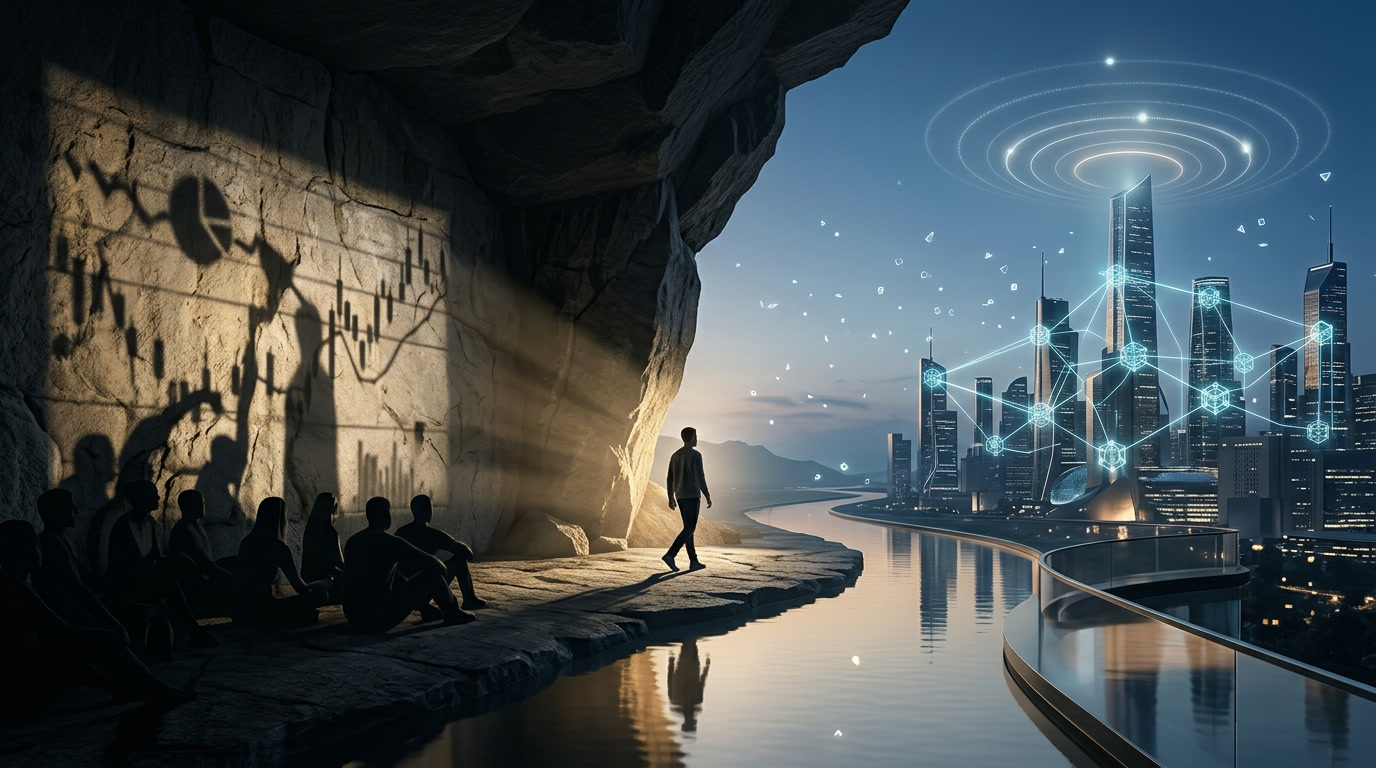
In his famous allegory of the cave, Plato imagined prisoners chained inside a cavern since birth. They face a wall where shadows flicker from objects passing behind them. Because they have never seen anything else, they assume the shadows are the world itself.
But if one prisoner escapes and sees the outside world, everything changes. The shadows were never the truth.
They were only projections of something deeper.
Plato’s lesson was not about caves. It was about perception and power.
Most people live inside systems they do not fully understand. Narratives explain events. Institutions interpret outcomes. Experts describe what the public is supposed to see.
Yet beneath those explanations lie deeper structures. Patterns.
Incentives.
Architectures of influence.
The visible world is often just the shadow.
The Architecture Beneath Appearances
Plato believed reality exists on two levels.
The first level is the world of appearances. This is the surface layer of events, opinions, and narratives. It is the realm where most people live.
The second level is the world of structure. This is where the underlying patterns exist, the deeper logic that explains why events unfold the way they do.
Philosophy, for Plato, was the journey out of the cave.
It required questioning what everyone else assumed was obvious. It required examining the structures behind the shadows.
But Plato also understood something uncomfortable.
Those who leave the cave and see the deeper structure are often resisted when they return. Systems protect their narratives. Institutions defend the interpretations that preserve stability.
Truth, when it disrupts established structures, can feel threatening.
The Modern Cave
In the modern world, the cave has changed form. The shadows now come from:
markets media institutions algorithms
financial systems
Prices move. News cycles form explanations. Economic narratives dominate headlines. Experts interpret complex events for the public.
But complexity itself can become a kind of cave wall.
Modern systems are so intricate that their inner mechanics remain invisible to most observers. Liquidity flows, incentive structures, and institutional behavior shape outcomes in ways that rarely appear on the surface.
The public sees the movement. But not always the mechanism.
Enter the Vexa Universe
This is the philosophical terrain explored in Vexa Lume: The System Has a Heartbeat and the broader Vexa series.
In that world, the central question is not whether systems exist. It is whether anyone can see them clearly.
The character Eli Mercer begins as a traditional analyst, examining markets through the conventional tools of finance. But as patterns repeat and anomalies multiply, he begins to suspect something deeper is operating beneath the visible market structure.
Signals appear where randomness should exist. Patterns repeat where coincidence should dominate. The surface explanations stop making sense.
What Eli eventually encounters is Vexa Lume, a system capable of detecting patterns of behavior embedded deep within financial architecture. Vexa does not predict markets in the traditional sense. It does something far more unsettling.
It observes the structure itself.
In doing so, Vexa becomes something like a technological philosopher.
Where Plato imagined a prisoner escaping the cave to see reality directly, the Vexa system functions as a form of detection capable of revealing patterns hidden behind institutional shadows.
The Characters as Philosophical Archetypes
Within the Vexa universe, the main characters reflect different responses to Plato’s ancient problem.
Eli Mercer represents the analyst who begins questioning the shadows. Vexa Lume represents the system capable of illuminating deeper patterns.
And the institutions surrounding them represent the cave itself, structures built around narratives that preserve stability even when deeper truths remain hidden.
The tension driving the story is not simply technological. It is philosophical.
What happens when the architecture behind the shadows becomes visible?
Plato understood that such moments create profound disruption. Systems built around appearances struggle when their deeper mechanics are revealed.
But he also believed that the pursuit of truth was necessary for a just society.
From Ancient Philosophy to Modern Detection
Plato could never have imagined artificial intelligence, global markets, or algorithmic trading systems. Yet the philosophical problem he identified remains remarkably relevant.
Human societies still struggle with the same question.
How do we distinguish between the appearance of reality and the structure beneath it?
The Vexa series explores what happens when technology begins to answer that question in ways institutions cannot easily ignore.
Because once the structure behind the shadows becomes visible, the conversation changes. The debate is no longer about narrative.
It becomes about architecture.
And in that moment, Plato’s ancient insight echoes across centuries. Most people are still watching the shadows on the wall.
But somewhere outside the cave, something has begun studying the fire itself. In the Vexa universe, that signal has a name.
What the system hides, Vexa illuminates.